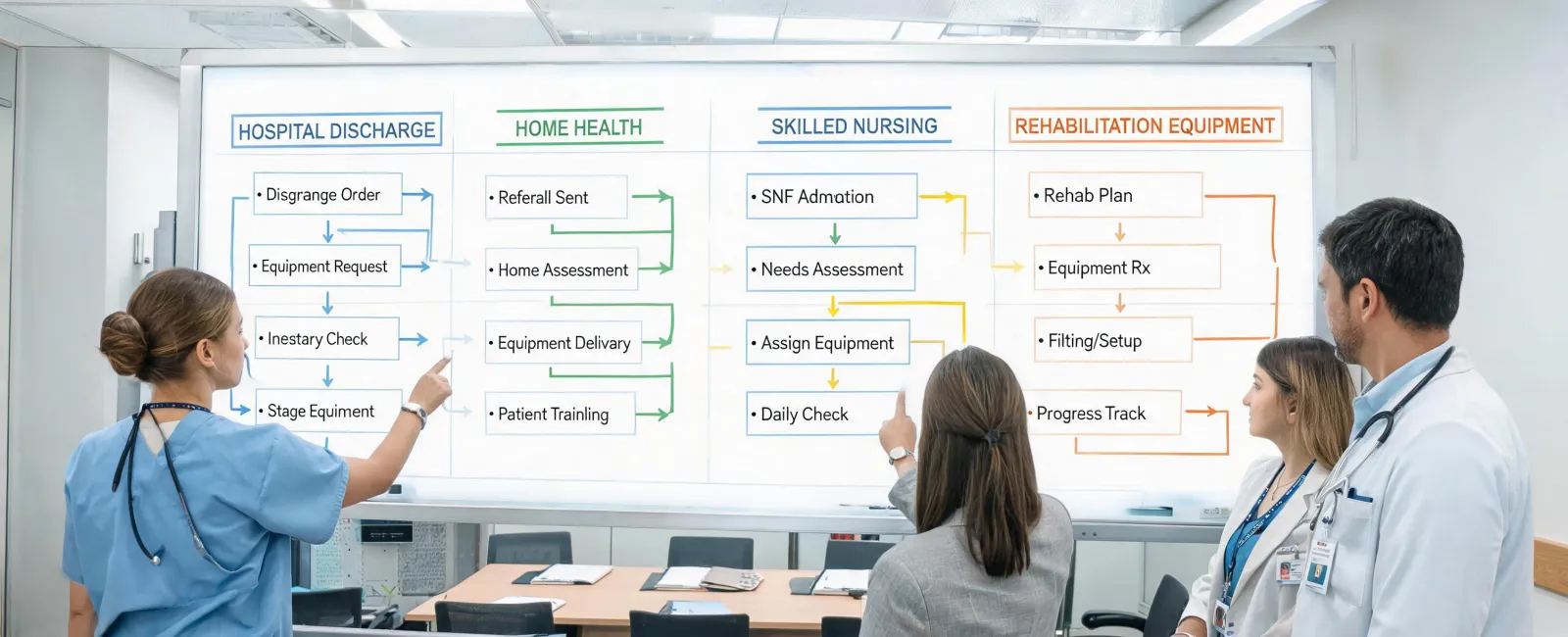
Hospital Discharge
Bed, lift, mobility, oxygen, and supply bundles prepared before discharge teams release the patient.
Clinical Applications
Invacare supports clinical applications where equipment leaves the controlled hospital environment and must still perform reliably in homes, skilled nursing rooms, rehab clinics, and distributed DME networks. The following use cases are written for operational buyers who need serviceability, training, reimbursement documentation, and patient support considered together.
Bed, lift, mobility, oxygen, and supply bundles prepared before discharge teams release the patient.
Fleet review for room turnover, transfer safety, infection control, lift utilization, and service scheduling.
Caregiver setup, telehealth observations, oxygen therapy checks, and remote escalation pathways.
Power mobility, manual wheelchair, positioning, rollator, and therapy equipment aligned to functional goals.
Regional catalog governance, parts continuity, quote routing, and payer documentation support.
Eligibility matching for VA, Medicaid, TRICARE, and local public programs with documented audit trails.
Transformation Cases
Standardized home hospital bed and patient lift requests across five discharge teams, reducing missing accessory callbacks within the first month.
Connected oxygen concentrator support, caregiver training, and service escalation into one request workflow for high-risk respiratory patients.
Aligned power wheelchair evaluation, replacement batteries, and seating documentation with therapy milestones and payer review.
Cleaned product catalog language, improved parts matching, and separated quote requests from urgent service cases.
Selection Trade-offs
Home-care and rehabilitation procurement rarely faces a single correct answer. The tables below present opposing clinical-operations views so value analysis committees can record the decision rationale beside 510(k) summaries and service SLAs.
CPAP / APAP view: Proven first-line therapy for moderate-to-severe obstructive sleep apnea, lower device cost, simpler titration, broad insurance coverage, and strong long-term adherence data for uncomplicated OSA.
BiPAP / ASV view: Better tolerated when high pressures are required, indicated for complex sleep apnea, COPD overlap, and selected central apnea pathways where fixed-pressure CPAP may fail adherence or clinical fit.
Invacare operating note: Device class is not selected from catalog preference alone. Sleep study interpretation, FiO2 needs, SpO2 monitoring plan, caregiver skill, and DME MAC documentation must be recorded before quote release.
Single-use view: Removes reprocessing liability, supports rapid ASC and home-visit turnover, and keeps sterility assurance predictable when Spaulding classification or home cleaning capability is uncertain.
Reusable view: Lower cost per use over a validated lifespan, smaller waste footprint, and acceptable risk when ANSI/AAMI ST91 / ISO 17664 reprocessing validation, SAL targets, and staff competency are proven.
Invacare operating note: Infection-control SKUs are quoted with cleaning workflow, waste handling, and complaint/PMS expectations so the facility infection-control committee owns the trade-off explicitly.
Care-Setting Spec Anchors